
AI and machine learning
We build AI that learns from your operations data and gives people advice they can check and act on: what is unusual, what is coming, and what to do next.
The problem it solves
AI pilots that never reach the floor.
A model that stays on an analyst’s laptop does not help an operator in the middle of a shift.
Without clean data and a clear decision to support, AI stays a demo.
What you get
-
A use case worth solving
A decision, a loss or a risk, chosen for its value and for the data available.
-
Data made ready
History cleaned and put in context, from your historians, databases and maintenance systems.
-
The right model
Prediction, classification, anomaly detection or forecasting: the simplest one that works.
-
Results that explain themselves
Each result shows why: the values, the comparison and the expected gain.
-
In the hands of people
A screen in the cab or the control room, an alert, a report or a OneStop app.
-
Watched over time
Accuracy followed, and the model trained again when the process changes.
Drill coaching
An underground drill coach, built as a proof of concept on simulated data.
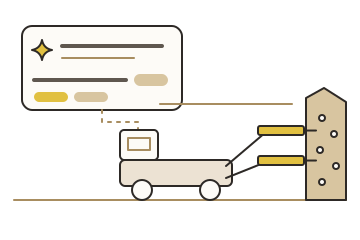
A face-drilling jumbo records its percussion, feed, rotation and flushing, its penetration rate, and each hole’s depth and angle against the plan. The models recognize the rock from these drilling parameters, learn the best settings from the best holes, see a jam or a flushing loss coming, and forecast the life of the bit and the time of the round.
-
Live, in the cab
A touch screen shows at most two suggestions at a time, each with its expected gain: collar at reduced percussion, reduce the feed before a jam, realign a hole off plan, change the bit after this hole.
-
Over the weeks
Each hole, round, shift and operator compared with the best practice in the same rock: metres per drill hour, round time, accuracy, bit life.
-
Coaching, not discipline
A note per operator and a weekly summary for the supervisor, written from the computed numbers only.
-
Tested before the drill
Five operators with different habits, changing rock and wearing bits are simulated, so the models are proven before they meet a real machine.
How it works
-
01
Frame
The decision to support and how success will be measured.
-
02
Prove
A proof of concept on your history, or on simulated data first.
-
03
Pilot
With the people who will use it, in their daily work.
-
04
Run
Monitored, trained again when needed, and handed over.
Outcomes
-
Decisions supported, not replaced
People see the advice and the reason behind it.
-
Gains you can measure
Agreed at the start, checked against the data.
-
AI people trust
No black box: every result can be traced to its data.
A good fit when
- You have years of history and a question it could answer.
- Failures, losses or variations that cost money keep coming back.
- Operators would act better with advice in real time.
- You tried AI and it stayed a pilot.
Common questions
Do we need a data scientist?
No. We bring the data and the modelling work, and leave tools your team can run.
Does our data leave the site?
Only if you agree. Models can run on your servers, and the choice of any cloud service is made with your IT team.
What if our data is not ready?
We say so and start there. See AI readiness.
Do you use large language models?
When the problem is language: questions, documents, reports, as in Ask PI, the assistant of TTech OneStop. For sensor data, other models often work better.
Start a conversation.
Tell us about your data and what you want from it. We will suggest a practical next step.