
Data integration and PI connections
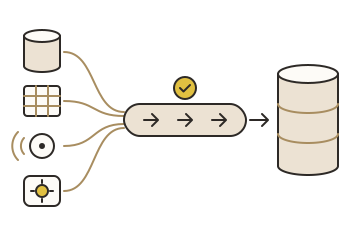
We connect the systems that hold your operations data, from new equipment to PI and from PI to your other systems, so the right values reach the right place on time, checked and documented.
The problem it solves
The data exists, but in too many places.
Production in the historian, work orders in the maintenance system, costs in the ERP, lab results in spreadsheets. People copy and paste between them, and every report starts with an export.
New equipment gets connected in a rush: unclear tag names, no buffering, and gaps found only when the data is needed.
What you get
-
Connections to your sources
PI and other historians, SQL Server and other databases, ERP and maintenance systems, files and spreadsheets, sensors and IoT gateways, web services and APIs.
-
New sources in PI
The right PI interface or PI Adapter for your PLCs, DCS and OPC servers (OPC UA, OPC DA, Modbus, MQTT and others), with buffering that keeps the data through network or server outages.
-
Pipelines that run on their own
Scheduled or continuous flows, with retries, backfill, and an alert when a flow stops.
-
One shared language
Names, units, time zones, production days and shifts aligned across systems; PI tags with descriptions, units and compression set to your standard.
-
Checks built in
Values, timestamps, row counts and gaps compared with the source, before handover and on every run.
-
Documentation
What flows where, how often, who owns it, and how to support it.
How it works
-
01
Map
The sources and their signals, the network path, the people who need the data, and the owners.
-
02
Design
The target (PI, a database, a data platform or an API) and the simplest path to it.
-
03
Connect and check
Build the flows, install interfaces or adapters with buffering, and compare the results with the sources.
-
04
Hand over
Monitoring of the flows, runbooks, and training for your team.
Outcomes
-
No more copy and paste
Data moves by itself, the same way every time, and reaches reports and tools on time.
-
Data you can trust
Correct values, timestamps and units from the first day, and one definition of each value from source to report.
-
Fewer gaps after outages
Buffering and backfill hold the data until the target is back.
-
Connections you can support
Documented, standard, easy to troubleshoot.
A good fit when
- People export from one system to feed another, or reports combine several systems by hand.
- You are adding equipment, a plant area or a new site, and need its data in PI.
- A vendor system holds data you need elsewhere, in PI or in your reports.
- You are preparing data for dashboards or AI.
Common questions
Which systems can you connect?
Any system with a database, a file export, an API or an industrial protocol: PLCs and DCS through OPC, PI Adapters, other historians, ERP and maintenance systems. We have deep experience with the PI System, and work with the others your site uses.
Where does the data go?
Where it is useful: PI, a SQL database, your data platform, or an app. We choose it with you and your IT team.
Do we need PI?
No. PI is one source among others. If you have it, we know it well.
Does it touch the control system?
PI and our flows read from the source. They do not write to it unless you ask for it. Network paths, accounts and change windows are planned with your control systems team.
Can our SQL tools read our AVEVA CONNECT data?
Yes. We have a working proof of concept of a connector that copies the AVEVA CONNECT streams you choose into a SQL Server table, continuously, with a backfill and a check against CONNECT.
Start a conversation.
Tell us about your data and what you want from it. We will suggest a practical next step.