TTech OneStop · Data and AI

Filon

All the data of the mine in one standard model, with the KPIs defined once, the reports ready, and every AI answer traced to its numbers.

The problem it solves

Every system has its own numbers.

Production, the plant, the laboratory, maintenance, energy and safety each keep their data in their own system, and each report computes its KPIs its own way.

Answers from AI are only useful when the numbers behind them are the same as the reports.

  • Demo on ten simulated mines
  • English and French
  • Hosted in Canada
  • Your Microsoft sign-in
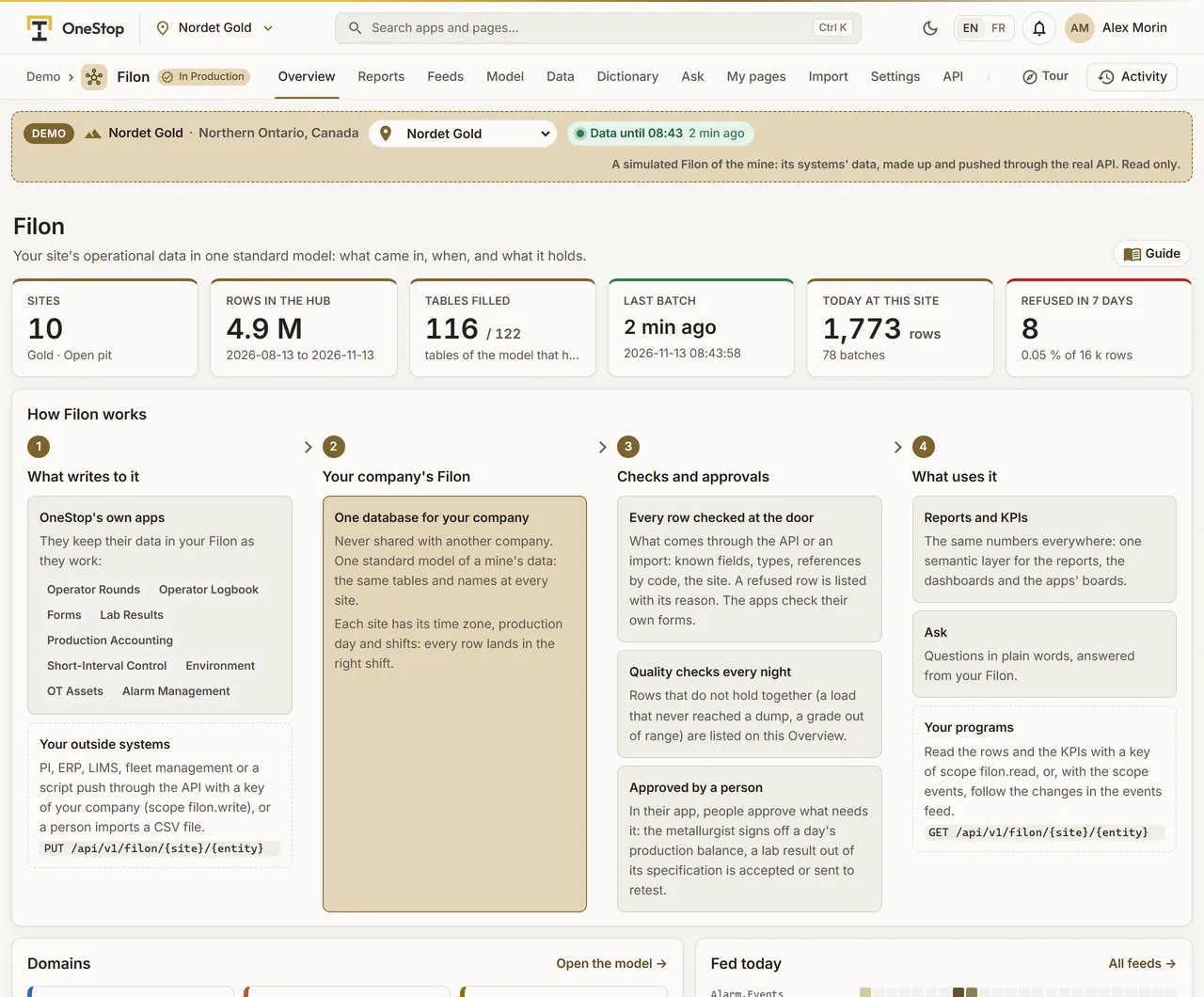
The overview of Filon on a simulated mine: figures, a card per domain, the feeds of the day and the quality issues
Demo section, simulated data.
  • One model15 domains of the mine, from the pit to finance.
  • 403 KPIsEach defined once, with its formula, in English and in French.
  • 65 reportsReady, by area, adapted to your type of mine.
  • Traced AIEach AI number shows how it was computed.
How Filon works

From your systems to your reports, through one model.

Filon is the data layer under OneStop. Your systems and OneStop’s apps write to it, it checks every row and files it in one standard model of the mine, and the reports, the AI and your own programs all read the same numbers from it.

You push your data. The model, the KPIs and the reports are already there.
Your part

Push your data

Your systems send their rows to one address, with an API key of your company. Or a person imports a CSV file.

  • PI System
  • Fleet management
  • LIMS
  • Maintenance
  • ERP
  • CSV file
PUT/api/v1/filon/{site}/mine.loads[{ "truck": "HT-101",
   "loader": "SH-02",
   "material": "HG",
   "payloadTonnes": 238.4,
   … }]
One truck load, for example. JSON or CSV, with your own codes.
Already defined in Filon Nothing to model, no KPI to define, no report to build.
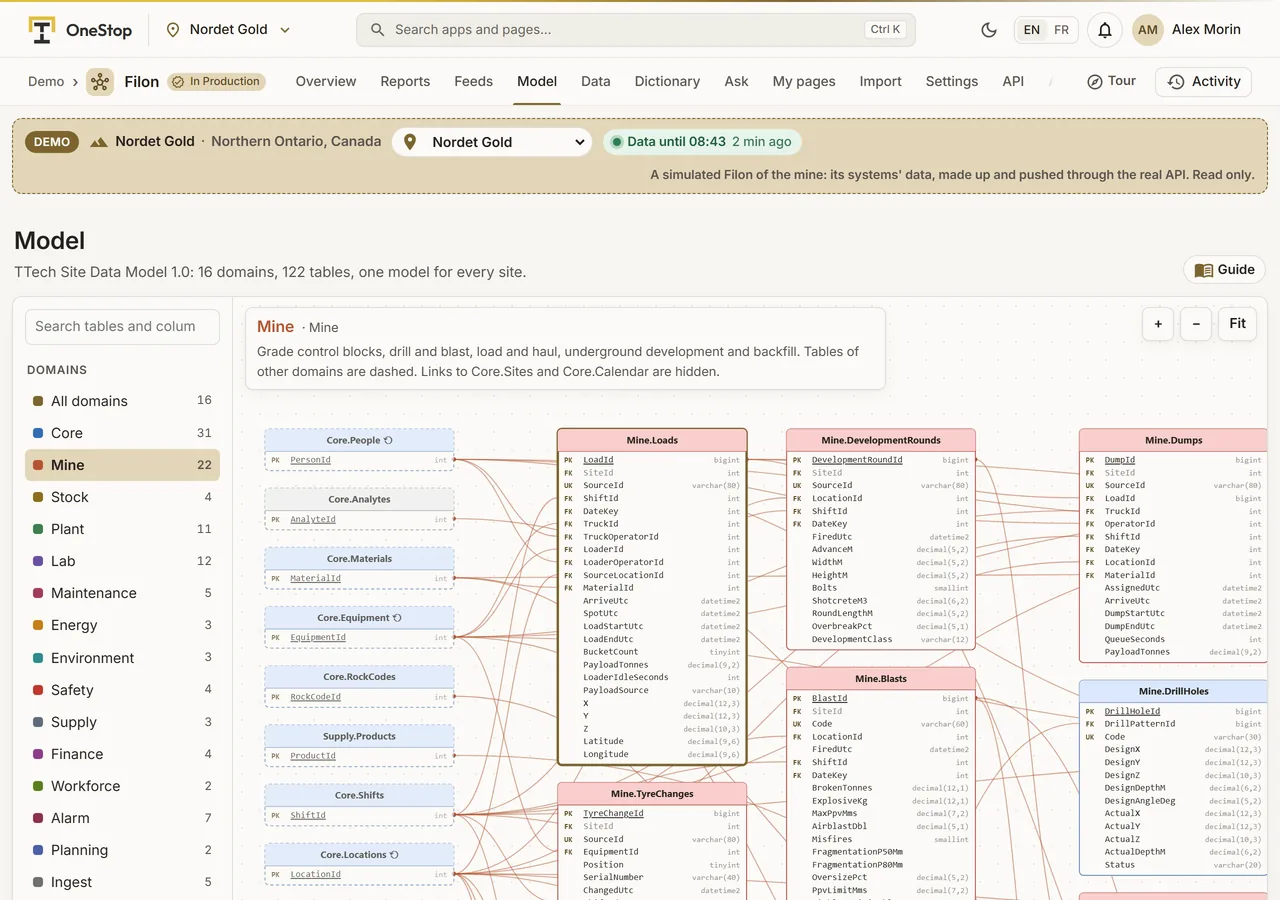
  1. The interactive diagram of Filon’s data model

    15 domains

    A standard data model

    One model of a mine site in 122 tables, the same at every site, switched on per site from its mining method.

    • Core
    • Mine
    • Stock
    • Plant
    • Lab
    • Maintenance
    • Energy
    • Environment
    • Safety
    • Supply
    • Finance
    • Workforce
    • Alarm
    • Planning
    • Ingest
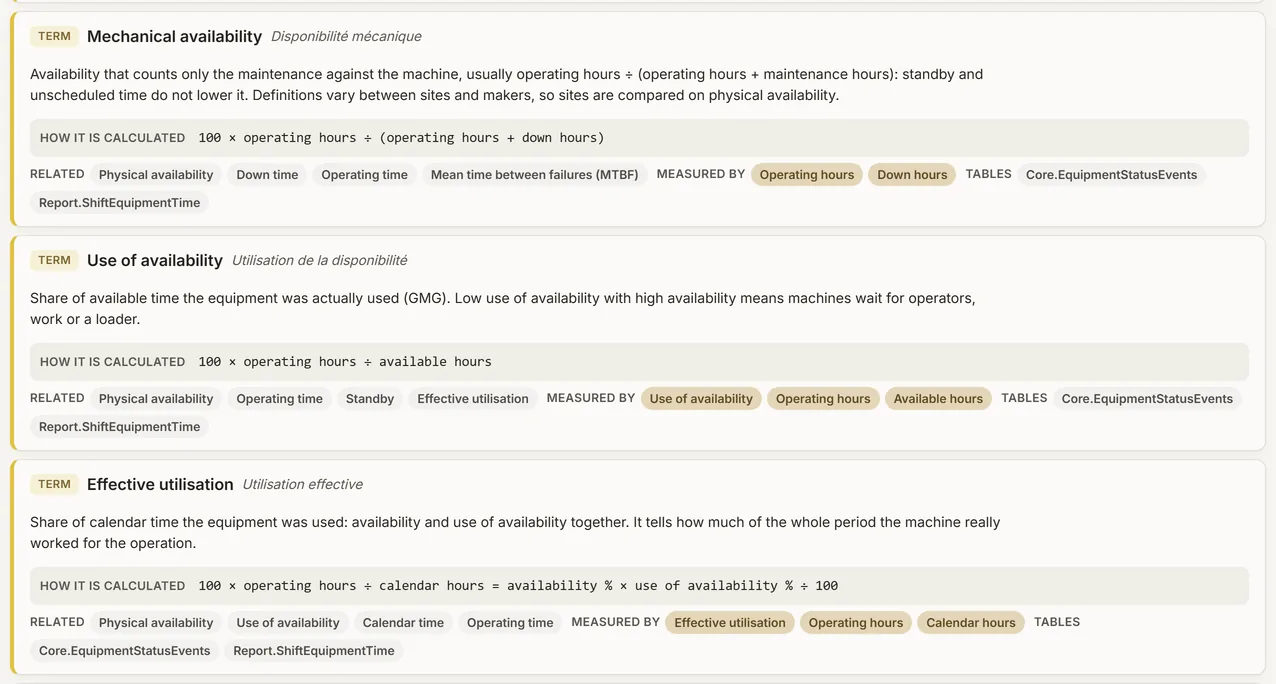
  2. A KPI in Filon’s dictionary with its definition and formula

    403 KPIs

    Standard KPIs

    Each defined once, with its formula, in English and in French.

    • Availability
    • Strip ratio
    • Truck cycle time
    • Head grade
    • Recovery
    • Electricity per tonne
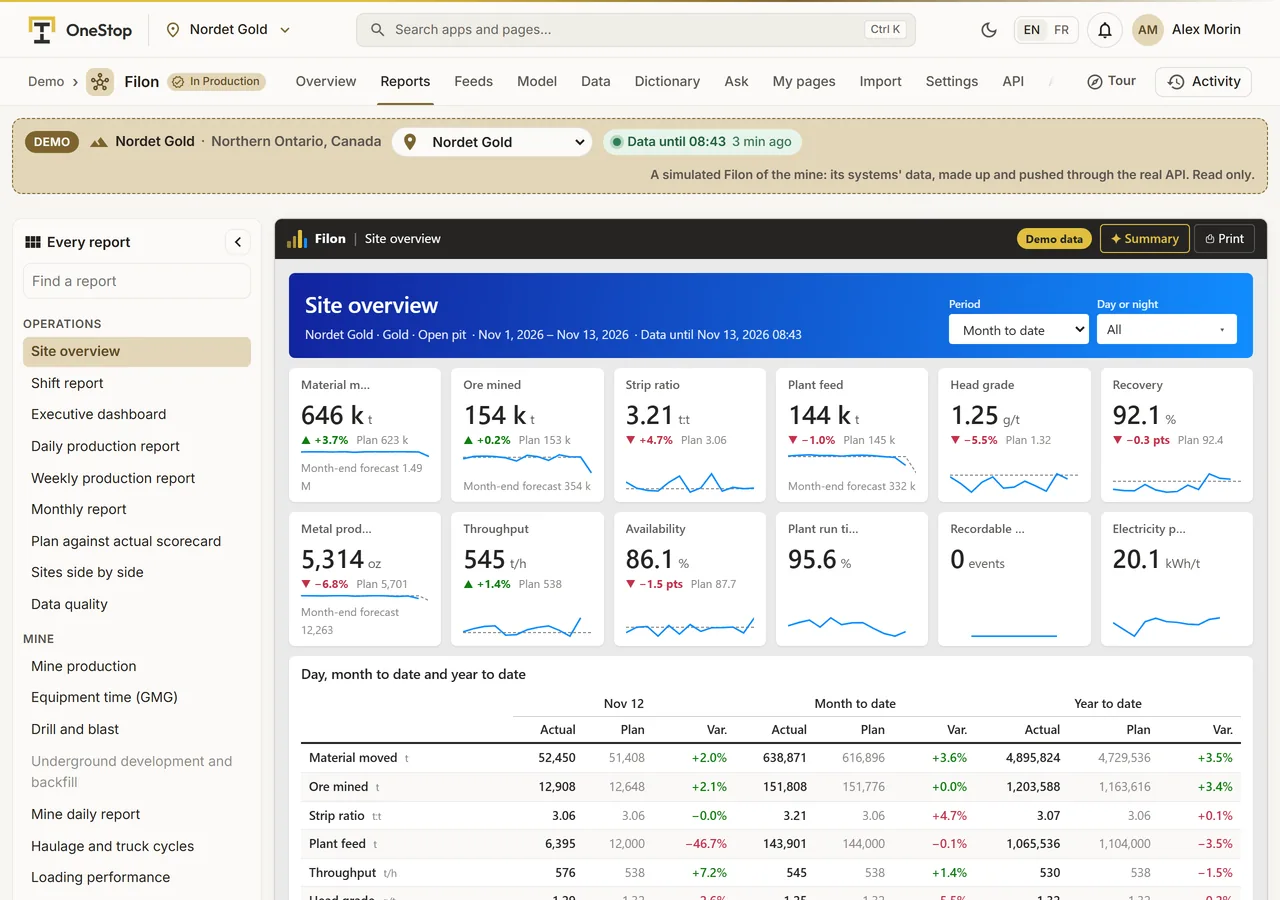
  3. A Filon report page of a simulated mine

    65 report pages

    Standard reports

    Ready by area and adapted to your type of mine, from the site overview to costs.

    • Operations
    • Mine
    • Processing
    • Geology and planning
    • Maintenance
    • Energy
    • Environment
    • Health and safety
    • Finance

Then read it your way: the reports, your own pages, Ask Filon and the API.

  1. Your data comes in

    Your systems push their rows through the API: fleet management, the LIMS, maintenance, the ERP, PI or a script. A person can also import a CSV file. OneStop’s own apps keep their data in Filon as they work.

    • JSON or CSV, up to 5,000 rows a push, into one table of the model.
    • Rows name things by your own codes, such as truck HT-101, never by our internal numbers.
    • The same rows sent again change nothing, so a system can safely send them twice.
    • The TTech Alarm Agent, a small Windows service at the site, pushes the control system’s alarm journal.
  2. Checked at the door

    Every row is checked before it is kept: known fields, types, times with their offset, references by code, the site. A row that fails is refused, never guessed, and listed with its reason.

    • Each push answers what was inserted, updated, unchanged and refused.
    • An unknown code refuses the row instead of creating a truck or a place behind your back.
    • The AI explains a batch’s refused rows and what to fix in the source system.
    • Every night, ten checks look for rows that do not hold together, such as a load that never reached a dump or a grade out of range.
  3. Your company’s own Filon

    Each company has its own database, never shared with another. Inside it is one standard model of a mine site: the same tables and names at every site.

    • Each site has its time zone, production day and shifts: every row lands in the right shift, daylight saving days included.
    • Parts of the model are switched on per site from its mining method: no trucks at a brine site, no development in an open pit.
    • Every change to sites, crews, locations, equipment, people and plant streams is kept.
    • Personal data and free text are encrypted with your company’s own key.
  4. One definition of each number

    One semantic layer computes every KPI the same way for the reports, your own pages, Ask Filon and the API.

    • 403 KPIs, each with its definition and formula in English and in French.
    • Weighted grades and ratios are computed from their sums, never as an average of averages.
    • Equipment time follows the GMG Time Usage Model.
    • A dictionary of the KPIs, 232 mining and data terms, and every table and column.
  5. Reports, pages and answers

    Filon’s 65 report pages read the model directly, by area, from the site overview to costs. The same numbers feed the pages you build and the answers of Ask Filon.

    • Slicers, cross-filtering, drill-down from the month to the hour, export to Excel and print.
    • Describe a page and the AI builds it from the KPIs; keep it private or share it with your company.
    • Ask Filon answers with the site’s numbers and shows how each one was computed; a number no query gave is flagged for checking.
  6. Out to your systems

    Your programs read the same data back with an API key of your company: the rows of any table, the model, the KPIs and a KPI query.

    • Each key has its scopes, read or push, and its sites if you choose.
    • Events as they happen, such as a batch received or a quality issue found, sent signed to your address or read from the events feed.
    • An OpenAPI description, and an API explorer that only checks a push unless you choose to write.

The standard model

  • CoreThe site, calendar, shifts and crews, locations, equipment, people, materials, units, analytes, KPIs and PI tags, shared by every domain.
  • MineMining blocks and their grades, drill and blast, load and haul, underground development and backfill.
  • StockStockpiles: movements in and out, surveys, balances and grades.
  • PlantProcess streams and their periods, grades, product lots and shipments, process values.
  • LabSamples and assays of the mine, the plant and the environment, with QA/QC.
  • MaintenanceWork orders, components and failures to ISO 14224, component changes.
  • EnergyMeters, readings and emission factors.
  • EnvironmentMonitoring stations, measurements and permit limits.
  • SafetyIncidents, safety actions, hours worked and leading indicators.
  • SupplyConsumables such as fuel, explosives, reagents, grinding media and tyres, with their transactions and stock levels.
  • FinanceCost centres, accounts, actual costs and budgets.
  • WorkforceAttendance, overtime, hires and departures, and training, as counts, never names.
  • AlarmThe control system’s alarm journal, the master alarm database, operator consoles and the site agents.
  • PlanningBudgets, forecasts and plans, with their values per KPI.
  • IngestBatches received, refused rows, code aliases, expected freshness and quality issues.
What changes

What changes for your team.

  • One definition of each KPI

    BeforeThe same KPI computed three ways in three reports.

    With OneStopEach KPI defined once, with its formula and the reports that use it.

  • Reports on day one

    BeforeMonths to build reports for each area.

    With OneStop65 report pages ready, by area, adapted to your mining method.

  • Data you can trust

    BeforeLate or refused data found at month-end.

    With OneStopEach feed’s health every day, and refused rows explained.

How it works

From your data to a decision, in a few steps.

  1. Push your data

    Your systems push JSON or CSV through the API, or you import a CSV with columns matched by the AI.

  2. One standard model

    Every row lands in the model of the mine, in your company’s own database.

  3. Checked every night

    Data quality checks run every night; each feed shows whether it is on time.

  4. Read it your way

    Reports, the dictionary of KPIs, your own pages, Ask Filon and the API.

Inside the app

The screens your teams use.

Each screen below is from the Demo section of OneStop, on a simulated mine. Ask us for a visit to try them yourself.

The overview of Filon on a simulated mine
Demo section, simulated data.
01 · Overview

The whole mine’s data, at a glance.

The figures of the site, a card per domain, a heat map of what was fed today, and the quality issues to look at.

  • Late feeds and refused rows stand out.
  • Each domain opens its tables and reports.
The interactive diagram of Filon’s data model
Demo section, simulated data.
02 · The model

One data model for the mine, drawn.

An interactive diagram of the model, with a sheet per table and examples of what to push.

  • Pan and zoom across the domains.
  • Parts of the model switched on per site, from its mining method.
A Filon report page of a simulated mine
Demo section, simulated data.
03 · Reports

Report pages ready for each area of the mine.

Operations, mine, processing, geology and planning, maintenance, energy, environment, health and safety, and finance.

  • Searchable, and adapted to the type of mine.
  • A summary by the AI, on request.
A KPI in Filon’s dictionary with its definition and formula
Demo section, simulated data.
04 · Dictionary

Each KPI, its formula and where it is used.

The definition and the formula of each KPI, in English and in French, its values at your site and the reports that use it.

  • The exact query behind each value, for your analysts.
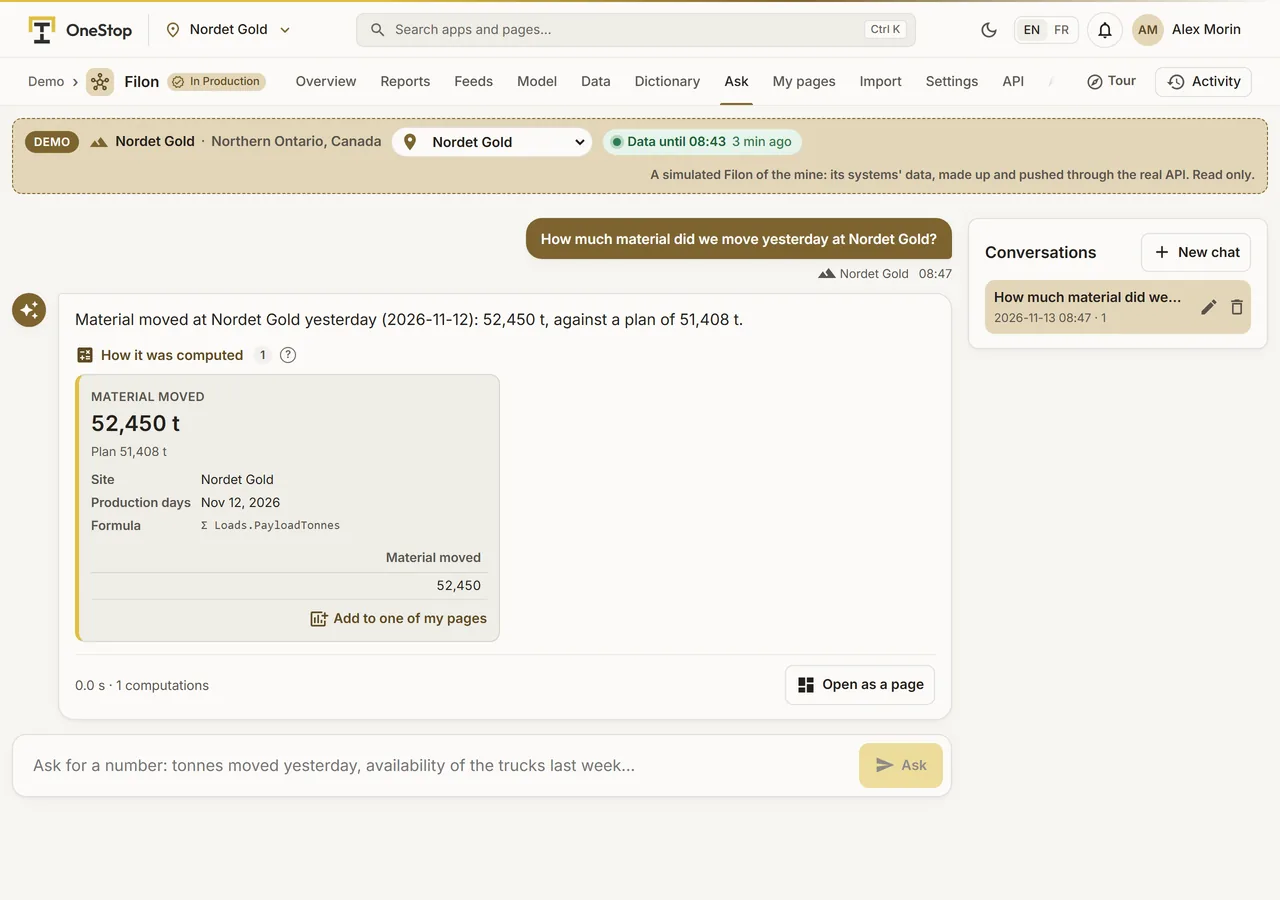
Ask Filon answering a question on a simulated mine
Demo section, simulated data.
05 · Ask Filon

Ask for a number, see how it was computed.

The AI answers with the site’s own numbers, the same as the reports, and shows how each was computed.

  • Build your own report page with the AI’s help.
  • Keep it private or share it with the company.
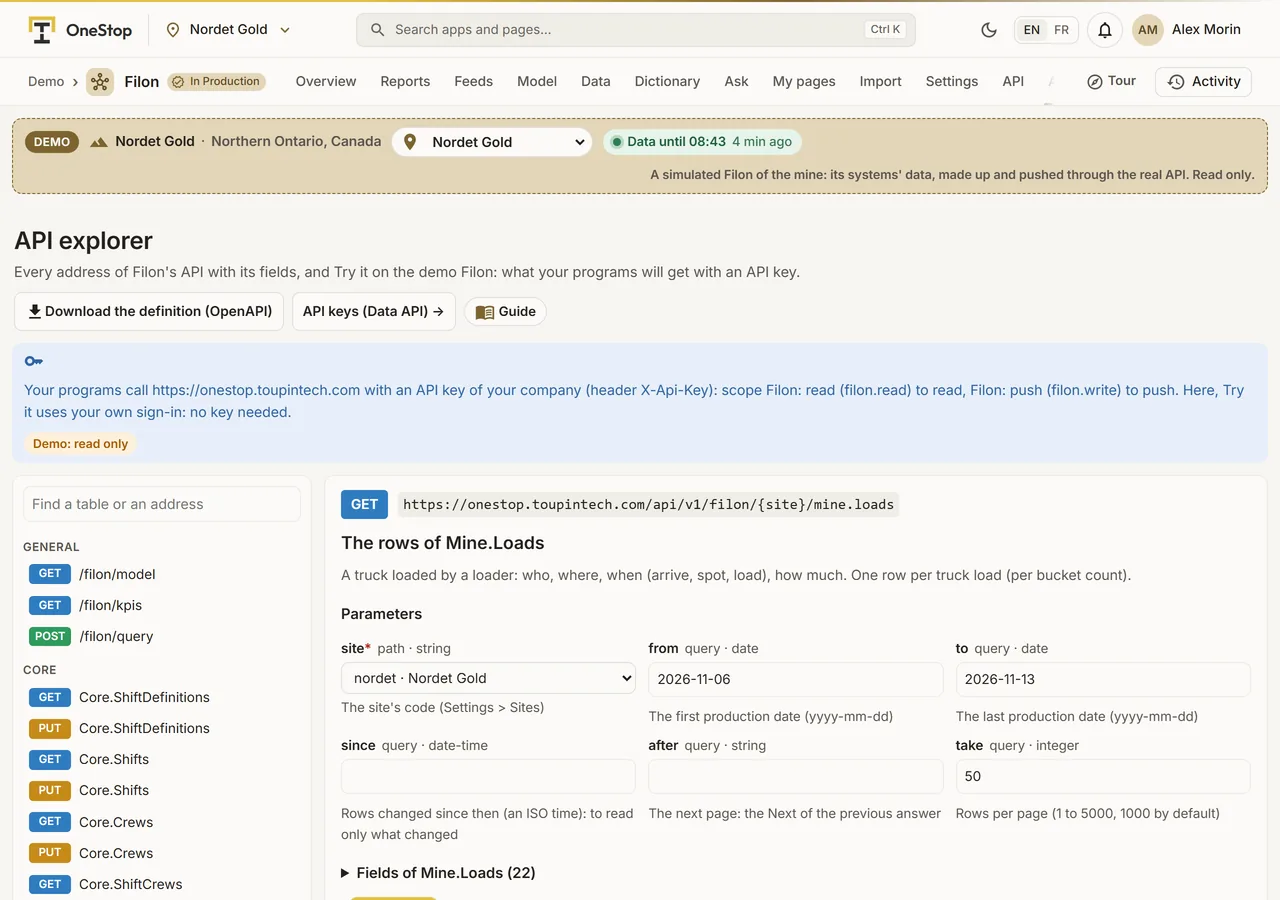
The API explorer of Filon
Demo section, simulated data.
06 · API

An open API, documented and ready to try.

An OpenAPI description to download for your tools, and a "Try it" on your own Filon that only checks a push unless you choose to write.

  • Webhooks and an events feed: a batch received, a quality issue.
What it does

Everything it does.

  • A standard model of the mine

    Core, mine, stockpiles, plant, laboratory, maintenance, energy, environment, safety, supply, planning, finance, workforce, alarms and more, in one database per company.

  • Data in, your way

    Push JSON or CSV through the API, or import a CSV with columns matched by the AI.

  • Feeds watched

    Each feed on time, late or with refused rows, a 7-day heat map, and the AI explains the errors.

  • 65 report pages

    By area, searchable, adapted to your type of mine.

  • A dictionary of 403 KPIs

    Definition, formula, values at your site and the reports that use each one.

  • Ask Filon and My pages

    AI answers with their numbers traced, and report pages you build with the AI.

Standards and integrations

Built on the standards and systems you already use.

Standards

  • OpenAPI 3The API described for Swagger, Postman and your own tools.
  • JSON and CSVThe two ways to push data.

Works with

  • Your systemsAny system that can send JSON or CSV: fleet, laboratory, maintenance, ERP, spreadsheets.
  • The Data APIRead your data back, with webhooks and an events feed.
  • OneStop appsAlarm Management’s indicators and other apps’ results in the same reports.
Who uses it

Made for the people who run the site.

  • Data and reporting teamsOne model and one set of KPI definitions to build on.
  • Managers and superintendentsReport pages for their area, ready.
  • Analysts and developersAn open API, a dictionary and the exact query behind each value.
Questions

What clients ask us.

Do we have to replace our systems?

No. Your systems keep running; they push their data to Filon, which brings it into one model.

Is our data kept apart?

Yes. Each company has its own database, and personal data and free text are encrypted with the company’s own key.

Can we try it?

Yes. The Demo section has Filon on ten simulated mines, fed live; it is read only.

Your data

Your data in this app.

What it reads, what it writes and who sees it. The whole picture: Security and trust.

  • Your own database

    One database per company, never shared.

  • Encrypted columns

    Personal data and free text are encrypted with your company’s own key; the data browser marks them with a lock.

  • Writes only when you choose

    The API explorer only checks a push unless you choose to write.

The OneStop way

Every app follows the same principles.

What is true of this app is true of every app of TTech OneStop: your data, your people and your language come first.

  • Your data stays yours

    The apps read your data through your own AVEVA CONNECT and write back only their own results, in their own streams. Your existing data is never changed.

  • Nothing to install at the site

    OneStop runs in the browser. Your administrator sets up one connection to your AVEVA CONNECT, once, and every app uses it.

  • Your Microsoft sign-in

    Your people sign in with their Microsoft work account. Your own admins decide who uses which app.

  • Explained, never a black box

    Every score, alert and AI answer shows its reason and where its numbers come from, in plain words.

  • English and French

    Every screen, every message and every report, in the language each person chooses.

  • By the piece

    Subscribe to the apps you need and add others later. Try each one first in the demo, on ten simulated mines.

See it on your own data.

Book a demo on our simulated mines, or tell us how you want to use it on yours.